Tuesday, June 13, 2017

Père Lachaise Cemetery

Dear Mark and Amy,

Before going on our one-week holiday, I returned to my favourite cemetery, the famous Père Lachaise, which is a bit north of Nation and sort of SE of République.  You, Paul and I can still remember playing in the Cemetery across from our home in Wadsworth.  I have always been attracted to them.  I never understood horror stories about cemeteries.  To me, they are quiet parks.

As we approach Père (Father) Lachaise, we see a large stone wall surrounding the acres of land.  In fact, the cemetery is built on a hill.


I no sooner entered and walked a bit before I saw this old memorial with the simple phrase, "Adieu, Mère" (we might now say, "Bye, Mom").


Unlike our cemeteries, some older European layouts have streets and alleys between the tightly-filled plots.  I have no idea why these tall structures were so popular (and some are still being built).  Possibly it makes it seem like the loved one has a solid home, and protected from the elements; therefore all is well.


You can tell if family members have not been cleaning their tombstones for a few years.  I like the moss, the softness it gives to the cold stone.  Crosses are omnipresent.


 As one proceeds further, you have to climb the hill.  This climb is rather steep, almost like going to two floors.  Some stairs are wide, others are narrow, possibly more like service entries.


Crosses will be a theme in these photos, so I won't keep noting their presence.  This was a Christian nation, and there are still millions of active Christians in France.


It was nice seeing an actual live flower, in bloom.  It was not plastic, it may not even have been carefully planned, but it was real in the world of hard stone.


Some small buildings have elaborate stained glass windows.  Most have been shattered, likely by freezing and thawing, or the buildings shifting on their small foundations.


Sometimes, the place seems to be a maze, totally confusing.  It can be challenging to find a specific marker, since each of the 90+ quadrants is fairly large.


I was impressed by this marker in honor of Gerda Taro, a journalist.  I hope to learn more about her contributions to the free press.


I like to return to the graves of Edith Piave and her family (sister).  I never heard her sing live, but have a complete set of her many CDs, each song being about three minutes.  What a voice . . . what a difficult life . . . all finally destroyed by drugs and alcohol.  Though surrounded by friends, she was forever lonely and fearful.  She basically raised herself and her sister, singing under windows for coins until they had enough for coffee.  Her grave is now a pilgrimage spot.  People even leave handmade mementos.


I also like to visit the large two-floor structure where urns are preserved.  I noticed that quite a few are once again empty, signifying that the family has not paid to renew the rental contract.  I saw that one impressive storm was on its way, so I managed to get to the upper walkway in time to stay more or less dry, in spite of the wind and sheets of rain.  Then, as suddenly as it had come, it was over.


 The floor has glass blocks which admit light to the basement level where still more urns are preserved.


Everything seems so dignified and proper, but again, one can tell which stones have not been visited and dusted lately.  The plastic flowers seem to anchor spider webs very securely.


Nobody seems to know who this intriguing young woman was.  Possibly a dancer, a flapper, an actress?  People have tried to figure it out, believe me.


I briefly tried staying dry in this entrance doorway, but the wind whipped the rain right through, so I trotted off to a much better doorway where one buzzes to get into a large complex of condos.


Finally, between showers, I managed to get away.  The streets smelled fresh from being washed by the rain, the sky was overcast, it all seemed hopeful.


All for now, with love from us both,
Evan

Friday, June 9, 2017

French Elections 2017, Round 1

Dear Mark and Amy,

As I write, people are voting in the UK and soon will be in France on Sunday.  I am feeling a bit 'election weary'.  Even though we live in Canada, we were forced to endure the dreadful US Presidential election banter and even some ads, and then it all ended so very badly.  Then, just before we flew to Paris last month, provincial elections were held in British Columbia, but the voting was so close that the recounts were not completed for two weeks.  France had presidential elections not too long ago and the country is now poised for its first round of elections for the National Assembly Sunday.

We don't have access to TV here, but I understand that no political ads are allowed on either the TV or radio except during a weekly specified 30-minute slot, and even these slots are available only during specific weeks.  So the French airwaves are not filled with the venom and hatred we endured for months last year.  There is plenty of information available on the internet and in articles, and radio and TV programmes call in representatives from the various parties for reasoned discussions.  The Presidential elections did have the well-publicized debates, which Aaron enjoyed following by internet.  I understand that the final debate cost Marine Le Pen the election.  She apparently interrupted continually, and lost her newly-assumed presidential cool, while Macron kept his calm.

The first thing I notice about politics in France is the number of parties.  It is not uncommon to have 15 candidates running in the first round.  In a sense, this sometimes means that people can vote their conscience in Round 1 and then vote strategically in Round 2 (which I rather like).  To see if I could get a better idea of what is happening, I walked to the local school this afternoon, where people will be voting on Sunday.  In France, large metal panels are set up for each election at each polling place, and the parties are each given one specific numbered panel on which they can post their information.  This usually consists of a large photo of two people, the Candidate, and (this is new to me) the suppléant (literally, the substitute, but possibly someone who will stand in or substitute for the main candidate under certain conditions.)

I took photos of the posters for the candidates running in Saint Maurice.  I noticed that boards 1 and 2 were vacant, so I assume that nobody is running locally for those national parties, whatever they might have been.  So let's skip that and begin with

No. 3:  PS, Parti Socialiste.  The Socialist Party is the nation's largest political party on the centre-left.  When we lived in France for a year, Mitterrand was its leader and the President of France.  The party then did less well under François Hollande, who stepped down after one disastrous term (his popularity rating of 4% is hopefully where Trump is headed).  Dominique Strauss-Kahn had been considered the party's leader-about-to-be-crowned until his escapades with women mad international headlines.  I see that the familiar red rose and red letters "PS" now have additional words, "Socio-Ecologie" [their bold type] with emphasis clearly placed on ecology.  I wonder whether this in response to the surging interest in ecology, and more specifically, in the Green Party.  No matter, the party is floundering.


No. 4:   577, Les indépendants de la droite et du centre (577, The Independents of the Right and Centre).  There are 577 seats in the French National Assembly.  This past April, the "577" party was renamed to specify that this organization or umbrella group supports independent candidates to the right and center.  This reminds me that the whole notion of a politician being on the left or right goes back to the way legislators are seated in the National Assembly in Paris.  The terms are also used in the US and Canada, even though their seating arrangements are totally different.  The page to the right of the photo is the candidate's statement (which was also distributed at the two local markets) telling us that this candidate has lived in Saint Maurice since 2002, is married, the father of two children, is 42, that he received his training in finance, etc., and then there is something said about Anne Buclin (48), is his suppléant.  It goes on to talk about his positions.  This is the most information given on any of the panels.


No. 5:   La République En Marche! (Forward, On the Move, etc.)  I believe this party was recently renamed, but they are still known mostly as En marche!  This is Macron's centrist party, which is bringing elements of the right and left together.  This is an ideal, in so many ways, but we don't yet know if he can make it work, for the problems are profound.  Since he was recently the big winner in the presidential election, his photo features prominently on every poster for his party.  In fact, many people seem to expect En Marche! to win, and some are even suggesting a possible landslide similar to the one enjoyed decades ago by Charles de Gaulle.  Time will tell.  So far, people are impressed by Macron, and especially by his reasoned and quiet responses to the unpredictable (and internationally illiterate) Trump. 


No. 6:  La France insourmise avec Jean-Luc Mélenchon.  This is a somewhat strange poster because you have to look carefully to find that the local candidate, Renaud Péquignot.  Jean-Luc Mélenchon is the party's leader and overshadows all else.  This party (I'll call it 'The Rebellious France') was founded in February 2016.  This is a radical leftist party with keen interests in eco-socialism, social-republicanism, humanism, antiliberalism, populism of the left, etc.  They had more than 530,000 members at the last count, but will not be playing a major role this weekend.


No. 7:  Parti du Vote Blanc (White Vote Party).  These folks advocate casting a protest vote.  A 'white vote' means that you have neither abstained, destroyed or mutilated your ballot.  Instead, you just turned it in blank--without a mark.  This shows that you have participated in the election, but found none of the parties or their candidates satisfactory.  These blank ballots are counted as part of the total number cast, making it a bit more difficult for any candidate to get an absolute majority.  In the last Presidential election, 12% of the ballots were blanks.  This type of protest is particularly popular in countries which require all citizens to vote.  (Appropriately, I find I now have a blank space which I simply cannot delete, so it goes.)


No. 8:  Front National (far right, nationalist party).  This party has been synonymous with the family name 'Le Pen' for decades.  Marine Le Pen's father founded the party in 1972.  Since the 1980s, she has devoted much of her energy to softening the party's image, downplaying her father's antisemitism, etc., and at one point even booted her father out of the party, trying desperately to distance the party from his rugged old ways.  In the last presidential election, some of her posters simply used her photo and her first name, Marine (trying not to conjure up the Le Pen name which so many have learned to avoid).   This rupture led to the joke comparing the year's two presidential candidates in Round 2:  Le Pen and Macron.  'One killed the father, the other married the mother" (recalling Greek mythology).  This party is known for wanting to close the nation's borders to immigrants and for voting to leave the European Union.  I notice that Marine's photo is not on the posters for this local candidate, possibly because she had to step down as party president in order to run nationally for President.


No. 9:   Union of the Right and the Centre.  This candidate is the Mayor of Maisons-Alfort (the city just across the River Marne from us) and his suppléant is the Vice Mayor (?) of Charenton-le-Pont, the city adjacent to Saint Maurice and where we get the métro.  His nomination is supported by various mayors. This makes me wonder whether the mayors are getting together, hoping to put local interests on the national agenda.


No. 10:   Union populaire républicaine.  These candidates are Eurosceptics, preferring the République (meaning put France first).  The party was founded in 2007, in response to unease with the ever-growing powers of Brussels and the European Union.


No. 11:   Debout la France! (Arise France!)   It took a while to get this party going.  It went through several names until its current one was selected in 2014.  The fellow on the poster is the party's founder, Nicolas Dupont-Aignan.   This party recalls some of the former Gaullist themes giving precedence to France.  They will apparently be doing well if they can get even 4% of the votes in any given town.


No. 12:   PCD, Parti chrétien-démocrate (Christian Democrat Party).  This right-wing party was founded in 2001 (you can see how many parties are relative new) and renamed in 2009.  They presently have only one member in the National Assembly, so this party is nothing like parties of similar names in other countries.


No. 13:   Europe écologie les Verts.  This party is a merger of several parties, including the Green Party.  It gets candidates elected at various levels (local, national, European), often attracting younger voters, but the party is not yet a major force on the political horizon of France, and is known to have hot debates internally.  However, I sense that its goals (and gains) have prompted other parties to pay more attention to ecology.


No. 14:   PCF, Parti communiste français.  This party used to be a force nationally, especially between the two wars, but now it occasionally seems to be about as old and tired as the man on its poster.  However, that is a misleading statement because the party actually has the third most paid-up members of any political party in France.  The PCF is particularly effective at the local level in the south of France.  It presently has 18 Senators and 7 in the National Assembly.


No. 15:   Parti Animaliste (the party that supports the animals--not to be confused with the film Animal Party).  I met a lady handing out flyers for this party, plaintively saying over and over, "For the poor animals".  In Paris and elsewhere, animals are important family members.  It is estimated that there are more animals than children in Paris.  The party was formed in 2014 and has candidates running in some 50 ridings. 


I can only hope that I am sort of on the right track for at least a few of these parties.  They have always confused me, so I decided it was time to try sort them out a bit.  I find several to be attractive, and wish we had many more parties in Canada.  I supposed we are fortunate to have five.

On my way to the school, I following this mother and son, and wondered if and how she would vote.


We are off to Burgundy, and will not have access to the internet until the following week, so, this is all for now, with love from us both,

Evan


Tuesday, June 6, 2017

A Sunday Evening with the Bloughs

Dear Mark and Amy,

I liked what you said the other day about waiting to read these letters until both of you can sit down and read them together, remembering things together.  This reminds me how Mother used to print email letters so that she could take them over to nursing and read them to Dad.  But after Dad passed away, Janice suggested in 2010 that, instead of emailing people, we start a blog with photos.  "This way, family can read our jottings if they wish to do so, and if not, there is less junk mail to delete."  Sadly, Dad never saw these postcards.

Speaking of memories, Pentecost Sunday was a day which brought back memories.  This weekend, we celebrated the Bloughs' 46th anniversary, recalling the time the Bloughs and we were joined by Alan and Ellie two years ago in Paris when we four Kreiders celebrated our 50th anniversaries together.

Janice and I skipped church (something my letters to Mom rarely revealed!)  I knew it was Pentecost and that the services would be special, but it seems that we are still getting slow morning starts, which has been our pattern in Paris these past ten summers.  I guess it suits us, and the bedroom drapes effectively keep the room dark.  Shortly before noon, we went to the market for cheese and veggies, and got the most wonderful Roquefort cheese.  I had to restrain myself at lunch, otherwise the entire slab would have vanished.  The markets offer much better cheese than we can get in Vancouver.  I think the refrigeration here is not nearly as cold and the stock moves quickly.  I can take cheese home from the market and eat it almost immediately, whereas in Vancouver, I have to let it sit at room temperature for several hours, and sometimes a Camembert even for days.  Anyway, I loved the Roquefort, which was surprisingly mild, and also the chevre (goat cheese). 

After lunch, we took the No. 24 bus from Charenton to Notre-Dame, the end of the line for holidays and Sundays).  We eventually decided to visit Janice's favourite bookstore, La Librairie du Jardin, which is dedicated entirely to books and magazines on gardening.  It is at the western end of the Jardin des Tuileries, the long formal garden stretching out from the Louvre (between the Louvre and Place de la Concorde).  I think you walked through it on one of your very first days in Paris, possibly on your way to St Eustache.  Well, it proved to be a long walk, rather longer than expected, and then we discovered that the bookstore is no longer there.  Yikes.  Janice later learned from La Figaro that the bookstore closed this past January, and some of the books dealing with historical gardens are now available in the Boutique du Musée du Louvre.  I always hate it when yet another of our favourite little places ceases to be (I'm still lamenting the closure of Vancouver's Chinese Impressions Restaurant almost 20 years ago).  Since Janice cannot load up on French gardening books, our luggage promises to be less heavy this trip.

Disappointed, we walked back east, nearly as far as we had already come, to St Eustache to hear the Sunday afternoon pre-Mass organ recital.  Philippe LeFebvre, the organist at Notre-Dame and teacher of improvisation at the Conservatory, played Duruflé's Op. 4, Veni Creator Spiritus (Come, Creator Spirit).  His fingers flying quietly over the keys created the most wonderful musical sensations of wind, or the coming of the Spirit as it is pictorially described in Acts.  The initial 15 minutes or so were filled with such amazing subtleties.  I also enjoyed watching his right foot quickly tap the metal peg (I don't know the correct term) which called up the next set of pre-programmed stops.  But sometimes, he suddenly decided he wanted a slightly different effect and quickly altered things by touching several other stops manually, all the while his other fingers and feet kept on moving.  Finally, toward the end, we got to hear the more sonorous variations on the chant hymn tune, with the obligatory all-stops-out for the final two pages.  I could feel my chest throbbing from the loud low pipes, yet my ears never hurt or even tingled.  Real (non-amplified) sounds are wonderful, but expensive to produce and maintain.  Anyway, we saved two seats for Neal and Janie, who arrived just before the organist was introduced to us.  As the photo suggests, we had prime seats for seeing the five-keyboard console. 

 After the recital, we stopped at a local café for something to drink.  I will never live down the drink I ordered:  "Sex on the Beach", but I simply had to try it.  This led to a stream of jokes at my expense, but 'it was really good for me.' (If it is alcohol-free, it is known as "Safe sex on the beach".)

We then took several métros, arriving at one of our favourite destinations, Le Bistrot de la Porte Dorée, where Neal had reserved the round table in the very private corner, probably the most private table I have seen in Paris.  After being seated, we remembered when the six of us ate across the room two years ago, a true celebration.  I also remembered introducing Jesse and Rapti to this bistrot last year, at this same private round table.

So, as requested, some photos of food.  After our apéros (kir and sparkling white wine) and pork rillettes (spread on thin pieces of whole wheat toast, the spread hopefully being no more than 50% fat), we had our entrées.  Janice and Janie selected the special, a dome of marinated raw salmon over goat cheese.  They loved it.


I had the assiette Périgord, a nice selection of cold cuts, including fried cold gizzards, a nice slice of the sweetest smoothest foie gras imaginable, some cuts of smoked/cured ham, a bit of duck confit, and the obligatory lettuce and tomatoes (I suppose a little decoration never hurts).


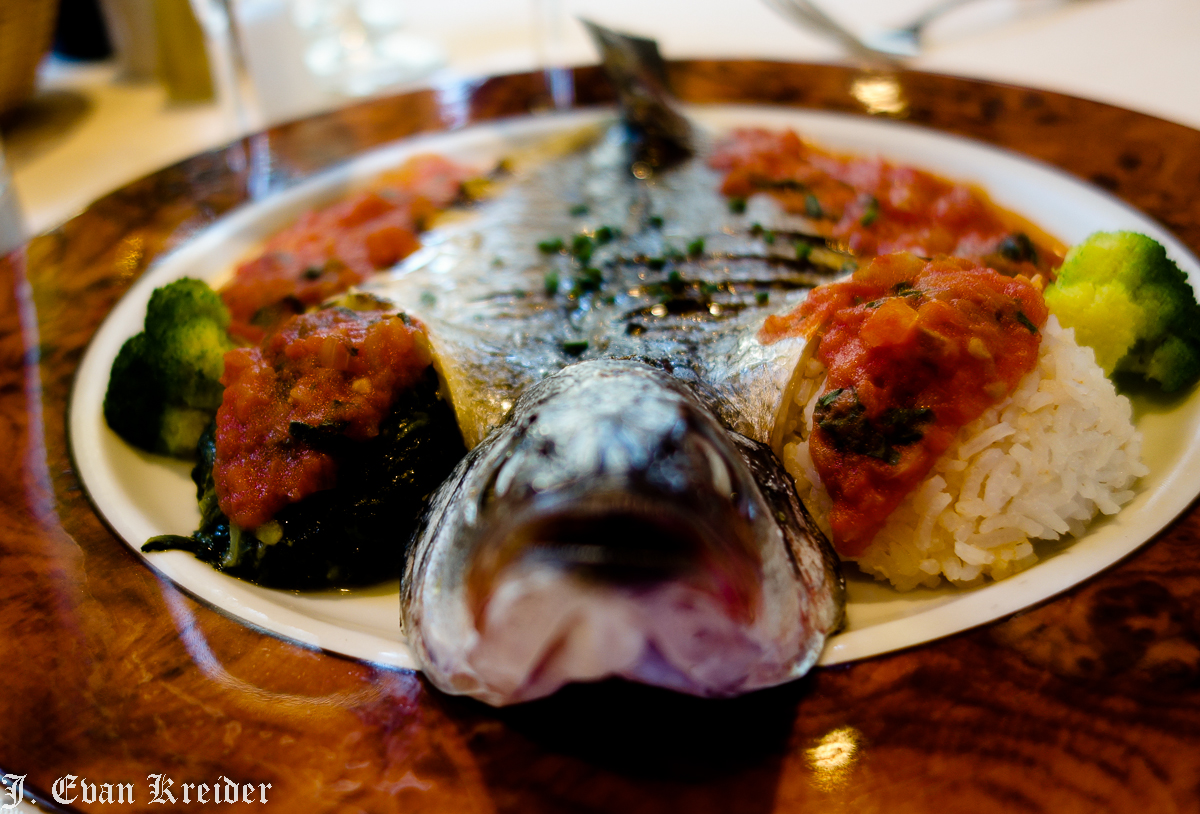
Main courses varied, but I got the usual, bar grillé (I have no idea what this fish is called in English).  The poor ex-swimmer's mouth was only barely open, and truly out of focus in this photo, but the tomato sauce was a perfect match for the delicate white fish.  When the course was finished, the waiter jokingly asked if I wanted him to wrap up the head to take it home.


Neal tried a new dish, beef steak and fried potatoes.  It looks very American, but he assured us that it was superb and most certainly not a mere steak with stuffed tomato and a mound of ratatouille (which was not at all runny) and sauce tartare.


I see that I neglected to photograph all the dishes, so I will hurry on to show three desserts, ending with my annual favourite, crêpes flambées au grand marnier, loaded with butter.  Janie and I each got four little crêpes, nicely folded into quarters.  I didn't want the dish to end, not ever.  Others settled for lesser desserts of chocolate covered profiteroles and sorbet.


After decaf espressos, we knew that the 25-minute walk home might be a better idea than taking a cab or the métro, so we left the Bistro and walked through the Parc de Vincennes, along the Lac Daumesnil.  It was 10:00 p.m., well after sunset and even nearly past the so-called 'blue hour', when cameras show things to be quite blue.  In the fading light, I had to shoot at f/1.2, which gives little depth of field, but some of the photos almost work.  First, we look back at the Bistrot de la Porte Dorée.


Neil, Janie and Janice walked on ahead, letting me linger for the occasional photo.


The swans are more than willing to end their day with torn bits of old baguettes.  I suspect that seeds would be more beneficial, but this is what is more readily available.  The Canadian geese had already settled on the grass for the night, safe on one of the two islands in the lake.


Seeing this couple led to a brief discussion on why women's shorts are so often shorter than men's.  As I recall, the men in our group were silent.


This family of four was closing shop for the evening; their picnic was over.  The children could stay up later because Monday is a holiday (Pentecost Monday).


I slept well last night, though most certainly not on my tummy!  Next time you come to Paris, we'll have to go to this Bistrot.  It was a bit out of the way for you on your last visit, and not nearly as historic as where we ate (Le Procope), but put it on your bucket list. 

With love from us both,
Evan